
Mason Bees and Leafcutter Bees for Sale
-
Mason Bee Cocoons (Osmia Lignaria)
Price range: $34.95 through $149.95 Select options This product has multiple variants. The options may be chosen on the product page -

-
Mason Bee & Leafcutter Bee nesting reeds
Price range: $8.95 through $17.95 Select options This product has multiple variants. The options may be chosen on the product page -
Complete Mason Bee & Leafcutter Bee Setups with Cocoons
Price range: $89.00 through $215.00 Select options This product has multiple variants. The options may be chosen on the product page -
-
-
Mason Bee House Kit & Leafcutter Bee House
Price range: $35.00 through $49.00 Select options This product has multiple variants. The options may be chosen on the product page -
-




Start Complete or Build It Yourself
Choose the setup that works best for you. Complete kits pair a chalet house with cocoons, making it a simple way to buy mason bees and leafcutter bees.
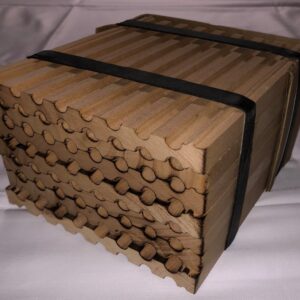
If you prefer to build your own setup, you can choose from nesting blocks with different hole counts, natural reeds, and a chalet house kit to hold everything together. Mason bee clay is available for sealing, while a cocoon comb helps seasonal harvesting easier. Storage bags help protect blocks and reeds once the season is over. Meyer Bees carries these products along with other beekeeping supplies.
Mason bees (Osmia Lignaria) emerge from their cocoons in early spring and are superior pollinators of apple, pear, almond, cherry, blueberry, and other early season fruit plants.
Leafcutter bees (Megachile Rotundata) emerge from their cocoons in early summer and are great pollinators of melons, cucumbers, beans, sunflowers, strawberries, other summer fruits and vegetables and virtually all summer-blooming flowers.
Contact us today to learn more.
Mason Bees & Leafcutter Bees
Mason bees (Osmia Lignaria) emerge from their cocoons in early spring and are superior pollinators of apple, pear, almond, cherry, blueberry, and other early season fruit plants.
Leafcutter bees (Megachile Rotundata) emerge from their cocoons in early summer and are great pollinators of melons, cucumbers, beans, sunflowers, strawberries, other summer fruits and vegetables and virtually all summer-blooming flowers.
Mason bees and leafcutter bees are solitary bees that are great for pollination. They are easy to manage and have relatively short seasons that line up with common blooms. They do not produce honey (see honey bees if you are looking for honey producing bees!) You can run both mason and leafcutter bees from the same chalet house as the leafcutters start up as the mason bees shut down.
Mount your mason bee chalet house so it faces south or southeast. This will provide maximum sun exposure.
The mason bees will not travel that far so be sure to locate the house within 300 feet of early season flowers, fruits and plants. The males will emerge first and need nectar-producing flowers right away. The females will emerge later, and they will require both nectar- and pollen-producing blooms. Once the spring blooms have diminished the mason bees will be done for the season. This typically happens around the beginning of June. At this point you can remove the mason nesting blocks and/or reeds and store them in a safe place away from predators. Remember to locate a source of clayey mud nearby so the mason bees are able to seal up each nesting chamber.
Starting around the beginning of June you can remove the leafcutter bee block from storage and place it into the empty chalet house and let the leafcutters begin the emergence process - this typically happens in 3 to 4 weeks around the 1st of July. The leafcutters will pollinate garden vegetables and other plants in bloom at that time. The leafcutters will typically complete their season by the end of September. After the season remove the leafcutter block and/or reeds and store them in a safe place away from predators.
FAQs
Are the cocoons available now?
Cocoons are sold seasonally, so they may not always be available. You can still purchase other supplies throughout the year and add cocoons when they’re back in stock. Contact Meyer Bees to check what’s currently available.
Nesting blocks or natural reeds?
Nesting blocks can be taken apart for cleaning, and you can inspect the cocoons at the end of the season. Reeds cost less and have a more natural look, but they need to be split open when it’s time to harvest. Some customers use both options to see which one they prefer and find easier to work with.
What is the cocoon comb for?
The cocoon comb is helpful when it’s time to harvest. At the end of the season, you open the blocks or reeds and separate the cocoons from the nesting material. Using the comb makes this easier than trying to separate everything by hand. It can also help you spot mites or damaged cocoons before you put the healthy ones into storage.
Will these bees sting?
Solitary bees are generally gentle and don’t have a colony to defend. They aren’t known for being aggressive toward people, so they’re a good fit for many home gardens. As with any bee, it’s best not to handle them and to give them some space.